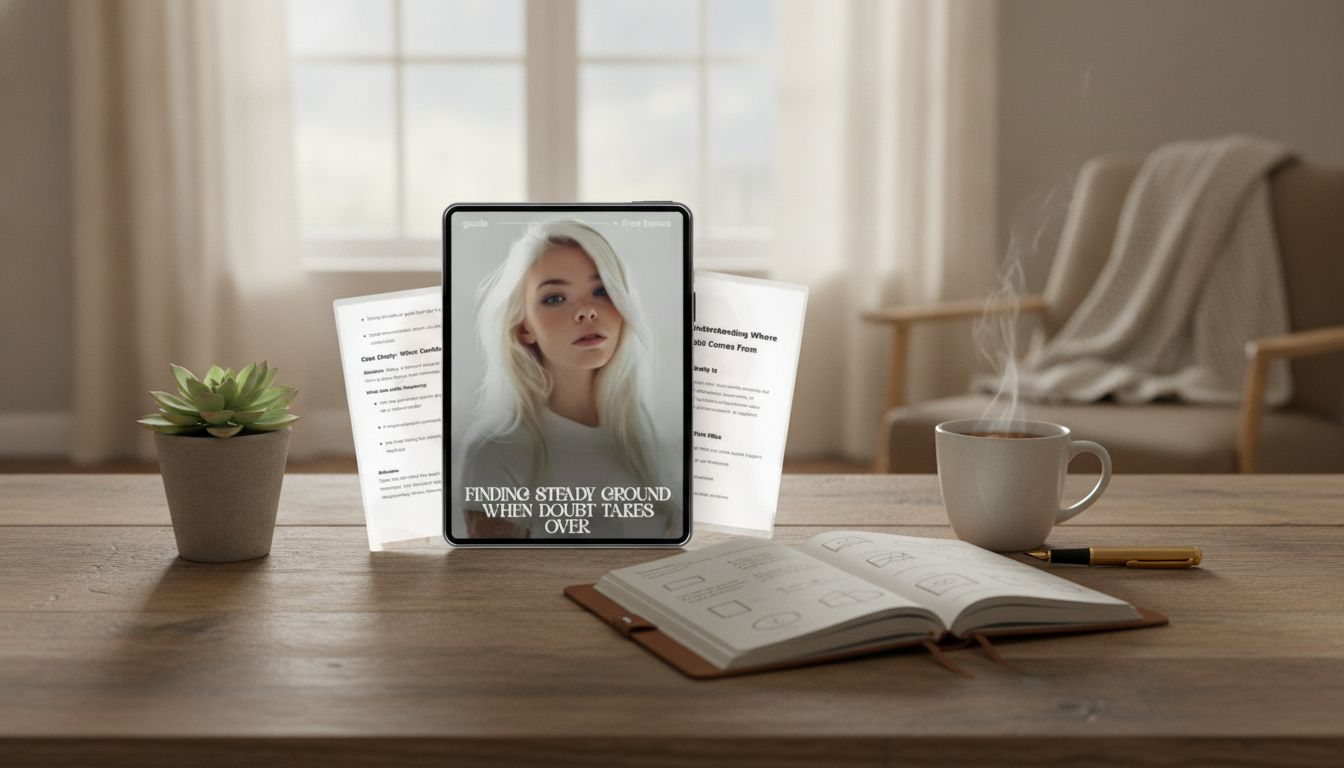
Self-doubt can feel like quicksand: the more it pulls, the harder it is to move. The goal isn’t to eliminate uncertainty forever—it’s to regain footing quickly and consistently. With practical, repeatable steps, it becomes easier to sort what’s true from what’s fear, calm the nervous system when pressure rises, and rebuild confidence through small actions you can actually track. A digital workbook format helps because you can return to the same steps whenever a new wave of doubt hits.
Self-doubt often shows up as mental overchecking, second-guessing, and postponing decisions until certainty feels “complete.” The mind treats uncertainty like danger, so it tries to reduce risk by analyzing everything—sometimes endlessly.
Common drivers include perfectionism, fear of judgment, past criticism, burnout, and unclear goals. When expectations are vague, the brain fills in the blanks with worst-case scenarios. When you’re depleted, even small choices can feel heavy.
Most importantly: doubt is not proof of incapability. It’s frequently a signal that something matters, that you’re stretching, or that a need is unmet (rest, clarity, support, boundaries). Learning to separate feelings (“I feel unsure”) from facts (“I lack skills”) reduces the urge to quit, overcompensate, or keep moving the finish line.
Doubt becomes a loop when it replaces decisions and actions with repeated checking. A few common signs:
When these patterns show up, the fastest way forward is usually not more thinking—it’s better regulation and smaller, more measurable actions.
When the body is in threat mode, the mind tends to interpret everything as proof you’re failing. A short grounding practice can help shift you back into clearer thinking. Try 60–120 seconds of slower breathing, relaxing the shoulders, and naming five things you can see or feel. This isn’t about forcing calm—it’s about turning down the intensity enough to choose your next step.
Identify the loudest doubt statement, then translate it into something more accurate and workable. “I’m going to mess this up” can become “I’m not fully prepared yet, so I’ll take one step that improves my odds.” The point is not fake positivity; it’s precision.
Take one small action that creates evidence: a rough draft, a single outreach message, a 10-minute practice block. Confidence grows from accumulated proof, not one big breakthrough. Track what you did and what you learned so doubt can’t rewrite the story later.
| Tool | Best for | How it helps | Try it when |
|---|---|---|---|
| Grounding (60–120 seconds) | Anxiety spikes, decision paralysis | Reduces physiological threat response so thinking becomes clearer | Right before a hard conversation or task |
| Cognitive reframing | Harsh inner critic, catastrophizing | Turns absolute judgments into balanced statements | After a mistake or critical feedback |
| Guided workbook exercises | Structure and consistency | Creates repeatable steps and measurable progress | When motivation is low but you want a plan |
| AI-assisted reflection prompts | Clarifying thoughts and options | Speeds up idea generation and helps surface assumptions | When stuck between choices or overthinking |
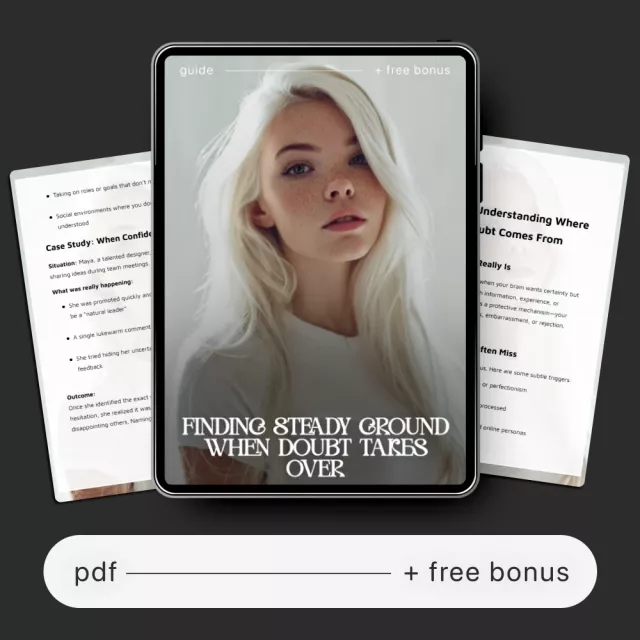
If self-doubt tends to come in waves, a repeatable system matters more than a one-time pep talk. The Finding Steady Ground When Doubt Takes Over digital workbook is built for that “return to it again and again” reality.
For creators who get stuck on how they “should” show up, pairing mindset work with a practical checklist can help reduce friction. The Snap It in Style: iPhone Outfit Photo Checklist supports simple, repeatable steps—useful when hesitation and perfectionism make starting feel harder than it needs to be.
If anxiety or stress is running high, evidence-based self-help skills can complement reflection. The APA’s guidance on resilience and the NHS overview of CBT techniques are practical starting points: American Psychological Association: Building your resilience and NHS: Self-help CBT techniques. For broader mental health support basics, see NIMH: Caring for Your Mental Health.
Confidence usually grows from repeated “evidence actions” rather than a single breakthrough. Many people notice a shift within a week of consistent practice, with stronger and more stable change building over several weeks.
It can be supportive because it focuses on skills like grounding, reframing, and routines that reduce spirals and improve follow-through. It’s not a replacement for professional care, so consider reaching out for help if anxiety feels severe, persistent, or overwhelming.
No—structured, step-by-step prompts make it beginner-friendly. The process is designed to move you from clarity to one small, doable action and a quick check-in.





Leave a comment