
Starting (or restarting) fitness in your 30s often collides with real schedules: work demands, family responsibilities, tighter recovery, and less time for trial-and-error. A simple plan that prioritizes consistency over intensity can build strength, improve energy, and reduce aches—without requiring perfect weeks. The goal: a repeatable routine that fits your life, adapts when things get busy, and still moves you forward.
For the next 4 weeks, pick one primary outcome to prioritize: strength, energy, stress relief, or mobility. When the target is clear, the plan becomes easier to follow—and easier to say “yes” to on busy days.
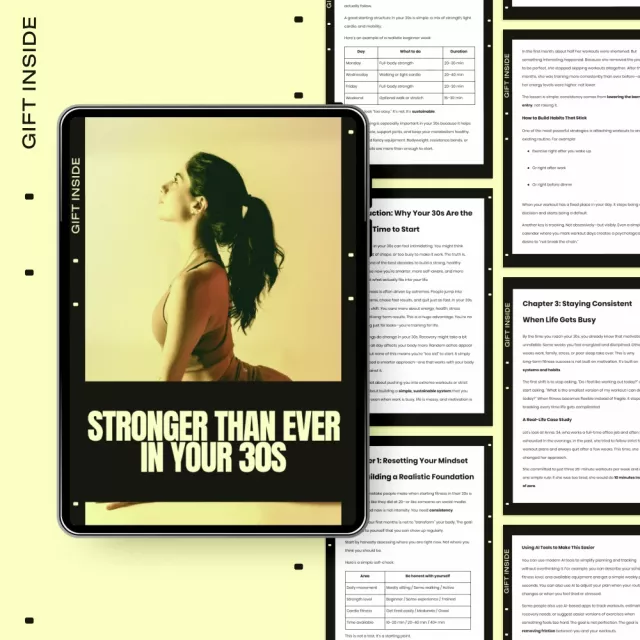
If you want a ready-to-follow framework that keeps you consistent (even when motivation dips), Stronger Than Ever in Your 30s – A Practical Guide on How to Start Fitness in Your 30s, Build Consistency & Create a Routine That Fits Real Life lays out a simple path you can repeat without constantly redesigning your week.
Most routines fail because they assume best-case weeks. Build for normal weeks first—then let “good weeks” be a bonus.
| Template | Days | What it includes | Best for |
|---|---|---|---|
| 2-Day Strength + Daily Steps | Mon/Thu + daily | 2 full-body strength sessions + 7–10k steps or 30–45 min brisk walking most days | Busy schedules, beginners, rebuilding consistency |
| 3-Day Strength | Mon/Wed/Fri | Full-body or upper/lower/full split; 30–45 min per session | Faster strength progress with moderate time |
| 2-Day Strength + 1 Cardio | Tue/Thu/Sat | 2 strength sessions + 1 bike/jog/row/swim (20–30 min) | Balanced fitness without overtraining |
| Micro-Workouts | 4–6 days/week | 10–20 min sessions: 2 strength, 2 mobility, 1–2 cardio | Parents, travelers, unpredictable weeks |
Strength training is the anchor in your 30s because it supports muscle, joints, posture, and day-to-day energy. Each strength session can be built from four movement patterns (plus an optional finisher):
Start with 2–3 sets per exercise at an effort that leaves 1–3 reps “in the tank.” That buffer keeps form clean and soreness manageable, which makes it more likely you’ll show up again next session.
Progress one variable at a time: add a rep, add a set, or add a little weight—no need to overhaul the whole workout every week. Consistent, modest progress beats sporadic “all-out” weeks.
When time is tight, the plan that survives is the plan with the least friction.
Fitness guidelines from the CDC and ACSM emphasize consistency across the week; your routine should be built to hit those targets even when life gets noisy.
To make “default meals” effortless, keep a few grab-and-go staples visible and easy to portion. A simple container can reduce decision fatigue; the Vintage Embossed Glass Storage Jar with Airtight Seal – 23.7 oz is a handy option for overnight oats, trail mix, or pre-portioned snacks you can rely on during busy weeks.
If you want a straightforward system built around real schedules, Stronger Than Ever in Your 30s – A Practical Guide on How to Start Fitness in Your 30s, Build Consistency & Create a Routine That Fits Real Life is designed to help you keep moving forward without needing perfect weeks.
Most people see clear results with 2–4 workout days per week, especially if strength training is the anchor. Add walking or step goals on non-lifting days, and prioritize consistency across months over a “perfect” week.
Start with low volume full-body basics for 4 weeks, aiming to finish workouts feeling like you could do a little more. Avoid crushing soreness by keeping 1–3 reps in reserve and progressing gradually (a few reps or a small weight increase at a time).
Use a fallback plan with shorter sessions to keep the habit intact, then return to your next scheduled workout without doubling up. A couple of “bare minimum” workouts can preserve momentum and make it easier to resume the full plan.






Leave a comment