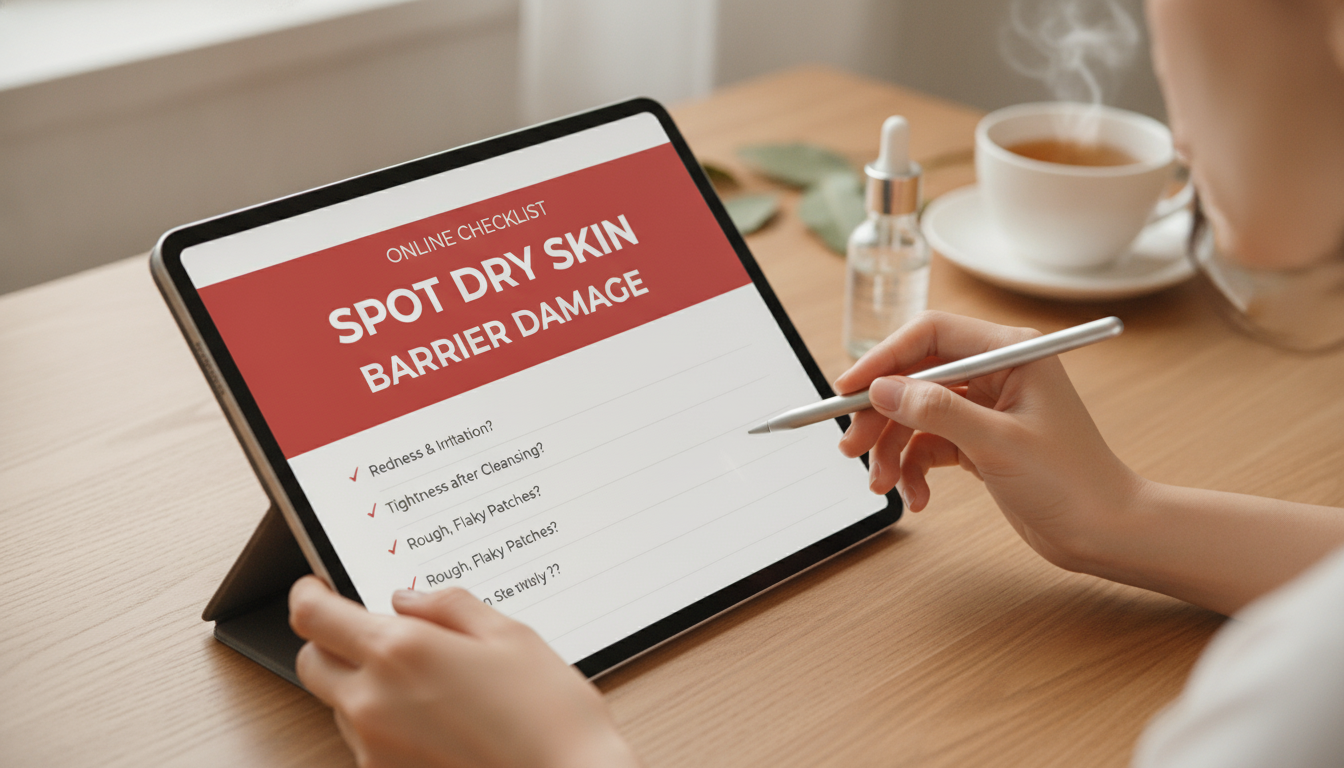
Dryness is common, but barrier damage tends to follow a distinct pattern: tightness that returns quickly, stinging with products that used to feel fine, and patches that won’t hold moisture. A simple, repeatable checklist makes it easier to separate “just dry” from “barrier under stress,” spot likely triggers, and decide what to change first—without guesswork. For more guidance, see Understanding the Epidermal Barrier in Healthy and Compromised ….
Your skin barrier (the outermost layer) works like a protective seal: it helps keep water in and irritants out. When that seal is stressed, water can evaporate faster and the skin can become more reactive—sometimes before it looks dramatically different in the mirror. For further reading, see How To Tell if Your Skin Barrier Is Damaged and What To Do About It.
For a deeper overview of how the barrier functions, the Cleveland Clinic’s skin barrier guide and the National Eczema Association’s skin barrier basics are helpful references.
Barrier stress tends to be “dryness with attitude”—meaning dryness plus reactivity. If several of the signs below show up together, especially in a repeating pattern, barrier support is usually the more productive first step.
| What you notice | More typical of dry skin | More typical of barrier damage |
|---|---|---|
| Tightness after cleansing | Mild to moderate; improves with moisturizer | Strong; returns quickly and feels uncomfortable |
| Product feel | Most products feel neutral | Many products sting, burn, or feel “hot” |
| Redness | Occasional or minimal | Frequent, reactive, patchy, or sudden flushing |
| Flaking pattern | Even dryness or seasonal scaling | Peeling in patches; makeup clings and separates |
| Sensitivity to weather | Worse in cold/dry air | Worse in cold/dry air plus sudden reactions to heat, wind, or friction |
| Time to improve | Often improves within days of richer moisture | Often needs trigger reduction + barrier-support routine for steadier recovery |
A barrier check is most useful when it’s consistent. Skin can feel calm at noon and irritated at night—so a tiny, repeatable log often tells the real story faster than memory does.
If you like using simple checklists to build consistent habits in other areas too, Snap It in Style: iPhone Outfit Photo Checklist – How to Take Outfit Photos with iPhone is another digital checklist option in the same “quick daily process” style.
Dry skin is primarily a moisture/oil shortage, while barrier damage usually includes sensitivity signals like stinging or burning, reactive redness, and reduced tolerance to normally gentle products. Tightness that quickly returns after cleansing—and irritation from products you used to tolerate—often points to barrier stress rather than dryness alone.
Mild barrier stress can start feeling better in a few days once triggers are reduced, but steadier comfort often takes about 1–3 weeks with a gentle routine. Recovery can take longer if irritation continues or if there’s an underlying condition like dermatitis.
When stinging, burning, or reactive redness is present, pausing exfoliants and reducing strong actives is often the fastest way to restore comfort. Once skin feels stable again, reintroducing one product at a time (with extra days between changes) helps confirm what your skin can tolerate.







Leave a comment