
Self-confidence grows fastest when small daily actions line up with personal values, strengths, and boundaries. When progress is built on repeatable habits (not perfection), it starts to feel realistic, measurable, and sustainable—whether the goal is speaking up, trying something new, or simply feeling more at ease in everyday situations.
Self-confidence is trust in your ability to cope, learn, and respond. It isn’t the absence of fear or doubt—it’s the willingness to move forward while those feelings are present.
A practical goal is to build evidence through action first—then let the “feeling confident” part catch up. This aligns with resilience-building approaches that emphasize skills and coping strategies over waiting for a perfect mindset (see American Psychological Association guidance on resilience).
Before adding new habits, locate what’s quietly leaking your confidence. A small change in one high-impact area often creates quick momentum.
If low self-worth is part of the pattern, the NHS self-esteem tips can be a helpful, grounded place to start.
Confidence grows through small “proof points.” The key is choosing actions that are easy enough to repeat, even on busy days.
| Day | Action | Time Needed | Proof You Did It |
|---|---|---|---|
| Day 1 | Write 3 strengths and 1 skill to practice | 5 min | Note saved on phone or paper |
| Day 2 | Do one small task you’ve been avoiding | 10–20 min | Task marked complete |
| Day 3 | Ask one clarifying question in a conversation | 1–2 min | Question asked |
| Day 4 | Move your body (walk, stretch, quick workout) | 10–30 min | Activity logged |
| Day 5 | Set one boundary (say no, delay, or request) | 2–5 min | Boundary communicated |
| Day 6 | Practice a skill for one focused block | 15–30 min | Timer completed |
| Day 7 | Review wins and choose next week’s focus | 10 min | List of 5 wins + next step |
Helpful self-talk isn’t about pretending everything is great. It’s about accuracy and direction—what’s true, and what’s the next useful step.
For additional basics that support mental well-being during stressful seasons, the National Institute of Mental Health guidance on caring for your mental health is a strong reference.
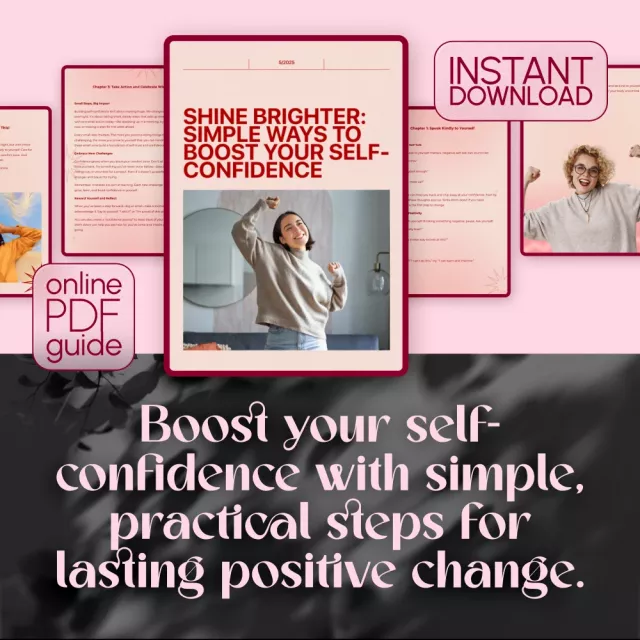
If you want a simple, organized way to practice, consider Shine Brighter: Simple Ways to Boost Your Self-Confidence (instant digital download). It’s designed for short, practical activities that help you build evidence quickly and revisit the exercises whenever you need a reset.
For confidence that shows up on camera (outfit posts, profile pics, or content creation), Snap It in Style: iPhone Outfit Photo Checklist can help reduce uncertainty with a repeatable, low-pressure checklist—so you spend less time second-guessing and more time capturing the shot.
Quick wins can happen in days when you keep small promises to yourself, but lasting confidence usually grows over weeks of repeated actions. Track one weekly metric—like “times I practiced micro-bravery” or “boundaries I communicated”—to make progress visible.
That’s normal because confidence is domain-specific. Borrow what works from your strong areas (preparation, practice, routines) and apply it as micro-steps in the areas that feel shakier, focusing on building evidence rather than chasing a perfect feeling.
Yes—confidence is a learnable set of skills, not a requirement to become more extroverted. Habits like boundary-setting, small skill practice, and accurate self-talk can raise confidence while your personality stays the same.






Leave a comment