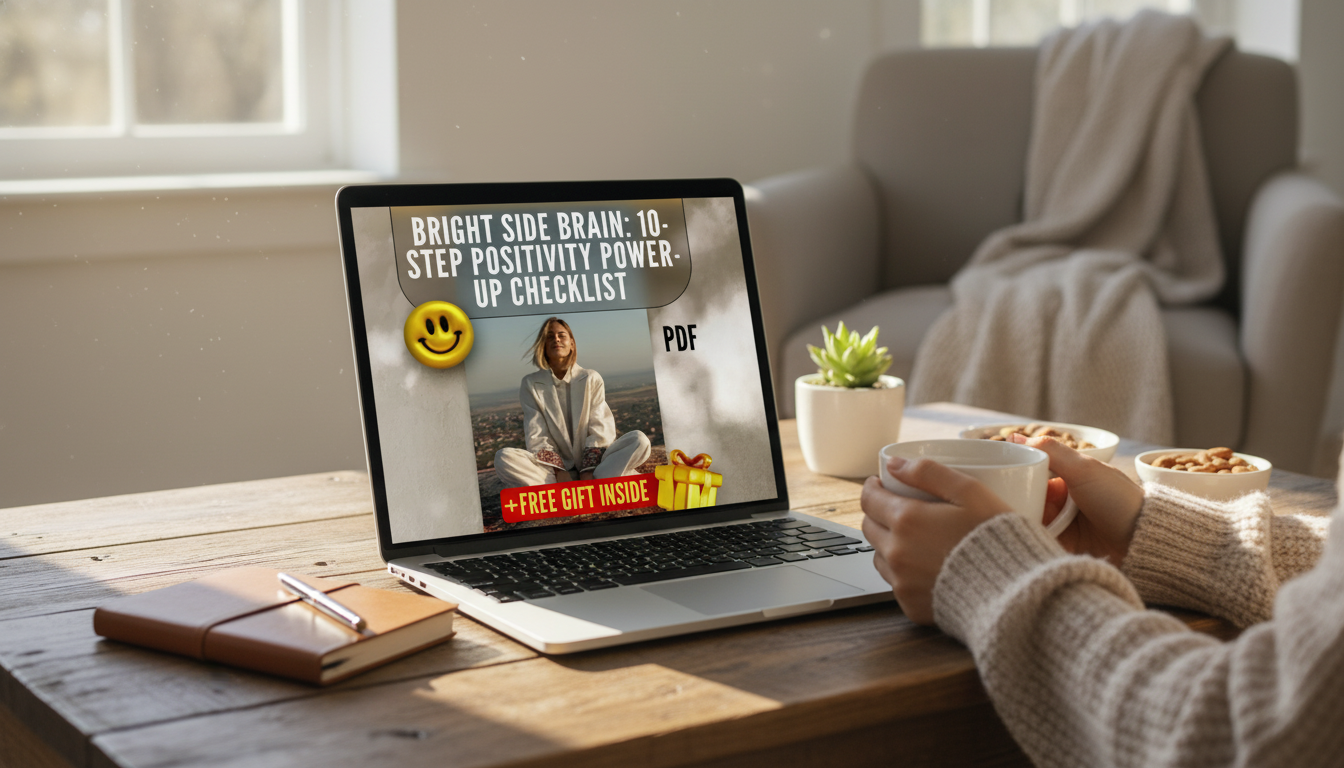
Stress can narrow attention, amplify worst-case thinking, and make it harder to access steady, constructive thoughts. A short checklist can act like a mental handrail—guiding attention back to what’s true, what’s controllable, and what helps. This printable digital download offers a 10-step reset designed for the moments when calm feels out of reach and a simple next step matters most.
The Bright Side Brain checklist is a 10-step, print-and-use tool built to help shift from stress-driven thinking into a steadier, more workable perspective. It’s especially useful when the mind feels “stuck” on spiraling thoughts, when decision fatigue makes everything feel heavy, or when a tough day is starting to define the whole week.
Because it’s a repeatable routine, the same steps build familiarity over time. That familiarity matters: when stress is high, having a known sequence reduces the effort it takes to begin. Many people use it during home stress (family logistics, caregiving), work breaks, study sessions, or right before difficult conversations where they want to show up with more clarity than reactivity.
It can also pair naturally with journaling, therapy homework, or a low-lift daily mental wellness routine. For a deeper understanding of how stress affects the body and attention, see the American Psychological Association’s overview of stress effects.
Speed is the point. Print one page and keep it visible (planner, fridge, desk, bedside), or store a digital copy where it’s easy to open when stress spikes. Start at Step 1 and move down the list without judging how long each step takes—some days Step 2 might take ten seconds; other days it’s the moment that changes the whole tone of your afternoon.
Mark completed steps with a pen or highlighter. The simple physical act of “checking” a box can add momentum when motivation is low. If time is limited, choose any three steps that feel stabilizing, then return later when you have more bandwidth. For habit-building, repeat the checklist at the same daily “stress cue” (after a meeting, before school pickup, at bedtime) so the routine becomes automatic.
| Situation | Fast approach | Goal |
|---|---|---|
| Racing thoughts | Complete the first 3 steps slowly | Lower intensity and regain clarity |
| Tight deadline | Choose 2 steps + one tiny next action | Move forward without spiraling |
| Emotional overload | Do the middle steps focused on perspective | Reduce catastrophizing |
| End-of-day stress | Finish the last 3 steps as a wind-down | Close loops and sleep easier |
This checklist follows a structured sequence that guides attention from stress signals to supportive thoughts and workable actions. Instead of insisting on “good vibes,” it uses prompts that help separate facts from assumptions and soften all-or-nothing thinking. That distinction—what’s known versus what’s feared—often reduces mental noise quickly.
The steps also include gentle reframes that encourage self-compassion without dismissing real problems. The goal isn’t to pretend everything is fine; it’s to create enough calm to choose a better response. Finally, it ends with a clear “next step” focus so the mind leaves the checklist with something doable, not just an idea.
For a practical coping overview that pairs well with short tools like this, the National Institute of Mental Health guide to caring for your mental health and the CDC’s stress coping resource offer straightforward strategies.
When stress is loud, overly cheerful wording can backfire. A helpful approach is to aim for “more balanced” rather than “positive only.” Balance is credible: it makes room for what’s hard while still widening the lens beyond worst-case thinking.
Each step can be treated like an experiment. If a prompt irritates you in the moment, skip it—momentum matters more than completeness. You can also anchor the routine to a small physical action (sip water, stand up, open a window, wash your hands). That tiny cue signals “reset” to the nervous system and can make the mental shift feel less abstract.
If having the tool ready-to-go would make it easier to use, the digital download is available here: Bright Side Brain: 10-Step Positivity Power-Up Checklist (digital download).
For a different kind of “checklist calm” (especially helpful when you want structure for a creative task), consider: Snap It in Style: iPhone Outfit Photo Checklist.
And if you like building a small “reset corner” at home—tea bags, mints, paperclips, affirmation slips—an attractive container can help keep it visible and tidy: Vintage Embossed Glass Storage Jar with Airtight Seal – 23.7 oz.
Yes. The steps focus on calming and balancing thoughts rather than forcing optimism. If it feels like too much, start with only a few steps that feel stabilizing and come back to the rest later.
Use it anytime stress spikes, and optionally once daily as maintenance. Repetition builds familiarity, which usually makes the reset feel faster and more natural over time.
Printed copies are great for visibility and habit cues (desk, fridge, planner), while digital copies are portable and more private. Many people use both, and a sleeve plus dry-erase marker makes the printed version easy to reuse.





Leave a comment