
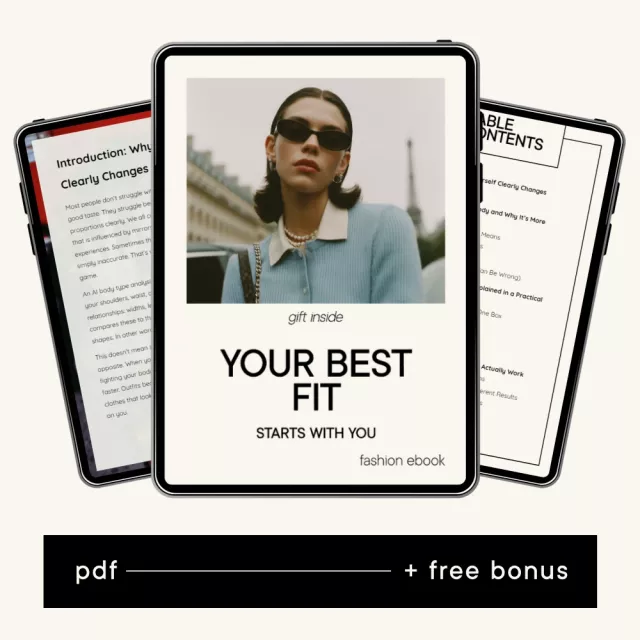
Personal style gets easier when outfit choices match real proportions—not guesswork. “Your Best Fit Starts With You” is a practical ebook that pairs body-type principles with an AI tool that reads a full-body photo and turns it into clear, usable styling guidance. The goal is simple: make shopping, outfit planning, and closet edits feel more confident and consistent—without getting stuck in confusing charts or rigid “rules.”
Most wardrobe frustration doesn’t come from not having enough clothes—it comes from not having a reliable way to predict what will look and feel right on your actual frame. This ebook is designed to help with:
If your closet is full of “almost-right” pieces, a repeatable process matters more than one-time tips.
AI body type analysis tools generally estimate proportion patterns from a photo (shoulder-to-hip balance, waist definition, vertical line, and overall distribution) and suggest a likely body-type direction. Used well, it’s a fast first pass that can save time—especially when you want a neutral starting point before you style or shop.
But AI is only as helpful as the input image. Results tend to improve when the photo is taken straight-on with minimal lens distortion and a clear outline. Common sources of error include angled poses, wide-angle lenses, bulky outerwear, and inconsistent camera height. For a broader view of why performance and evaluation matter with algorithms, see the ongoing work from NIST, and practical guidance on responsible AI claims from the FTC.
Best practice: use AI for speed, then confirm with a few simple checks so your styling choices stay grounded in what you see on your body in real life.
Small photo tweaks can dramatically change the output—so it’s worth taking five minutes to set yourself up well. Aim for consistent camera height, clean lines, and a natural stance.
| Setting | Aim for | Avoid |
|---|---|---|
| Camera height | Mid-torso or chest height | Low angles that lengthen legs unnaturally |
| Lens & distance | Step back and zoom slightly if possible | Close wide-angle shots that warp proportions |
| Pose | Neutral stance, shoulders level | Hip popped, twist, or leaned posture |
| Clothing | Fitted tee/tank + leggings | Oversized sweaters, thick jackets, shapewear extremes |
| Background & light | Plain wall, even front light | Busy patterns, harsh shadows, backlighting |
A useful analysis doesn’t end with a label. The real win is turning what you learn into consistent outfit decisions—especially when trends change or sizing varies by brand.
For example, if your outfit often feels “top-heavy,” you can test a different shoulder line (scoop vs. square vs. open collar), shift waist placement (high-rise vs. mid-rise), or change hem endpoints (cropped jacket vs. hip-length). These are fast edits that change the overall silhouette without replacing your whole wardrobe.
This ebook is built as a workflow you can repeat whenever you shop, pack, or reassess your closet:
If you want the guided approach, you can find it here: Your Best Fit Starts With You – Practical AI Body Type Analysis Ebook.
To keep the photo setup simple and repeatable, pair the ebook with: Snap It in Style: iPhone Outfit Photo Checklist.
Accuracy varies based on photo quality, pose, lens distortion, camera height, and clothing. Using 2–3 consistent images and confirming results with a few practical checks makes the output far more reliable. Treat AI as a starting point, not a final verdict.
Wear simple fitted basics like a tee or tank with leggings in neutral colors, with even lighting and a plain background. Avoid bulky layers and extreme shapewear that significantly changes the visible outline.
Yes—when you know which necklines, rises, and hemlines consistently suit your proportions, it’s easier to choose items that match your “proportion formula.” Keeping a short personal checklist and comparing key garment measurements can reduce experimental buys and improve fit consistency.





Leave a comment